Blockchain technology continues to evolve at a rapid pace. Just a few years ago, the market was crowded with projects positioning themselves as “Ethereum killers,” but today we are seeing a very different trend. The spotlight has shifted to ecosystems that do not compete with existing networks, but instead connect them, creating a scalable and interoperable infrastructure for Web 3.0. Polkadot (DOT) is exactly this kind of project — a cryptocurrency and multi-platform network that focuses on blockchain cooperation rather than isolation. In this article, the Crypto Insite editorial team takes a deep dive into what Polkadot is, how its revolutionary parachain technology works, and why this project is considered one of the most promising in the industry. We analyze the current DOT price, explore the platform’s technical features, and present forecasts from leading analysts for 2026 and beyond.
Imagine an internet where different websites cannot exchange data — that is essentially what the blockchain space looked like before solutions like Polkadot emerged. Polkadot changes this paradigm by allowing dozens of independent networks to run in parallel and interact with each other through a single relay chain. At the time of writing (January 2026), the DOT token is trading in the range of $2.04–$2.07, and the community is actively discussing its growth potential amid the launch of Polkadot 2.0 and upcoming upgrades. In this guide, we explain where to buy and how to store DOT, break down earning opportunities through staking, and answer the most common questions from investors. Let’s dive into this multichain ecosystem!
Polkadot is a full-fledged next-generation blockchain platform that functions as an “internet of blockchains.” In simple terms, it is a technological infrastructure that allows different blockchains to communicate with each other and exchange data and assets without intermediaries. Think of Bitcoin, Ethereum, and other networks as separate islands in the ocean, while Polkadot builds bridges between them, enabling seamless movement and interaction.
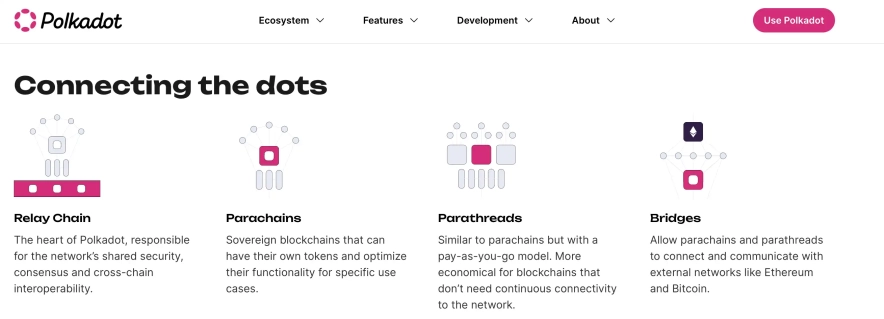
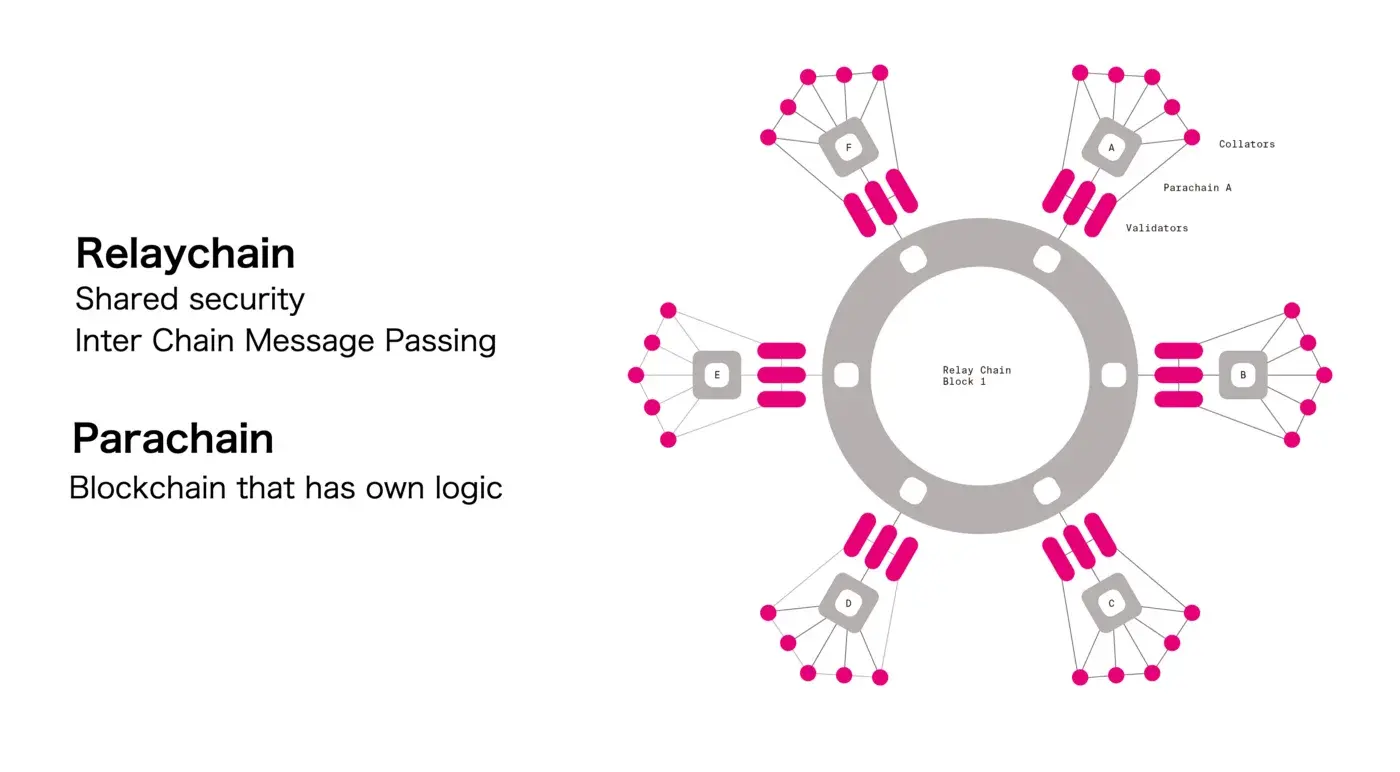
At the core of the project is the concept of a multichain architecture, which fundamentally differs from traditional monolithic blockchains. Instead of processing all transactions and smart contracts within a single congested network (as was the case with Ethereum 1.0), Polkadot distributes the workload across multiple parallel chains known as parachains. Each parachain is an independent blockchain with its own rules and functionality, yet all of them are connected to a single central chain called the Relay Chain.
Polkadot (DOT)
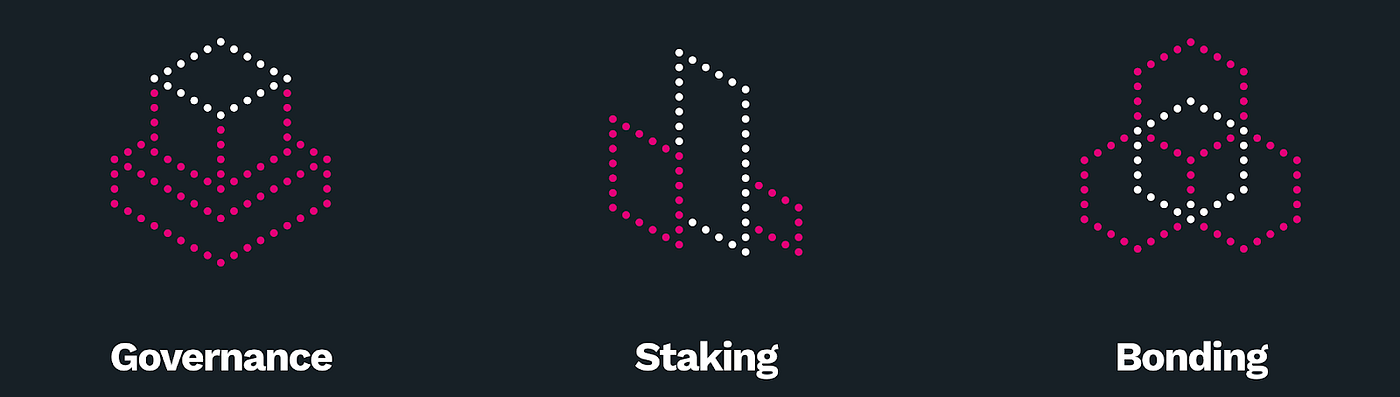
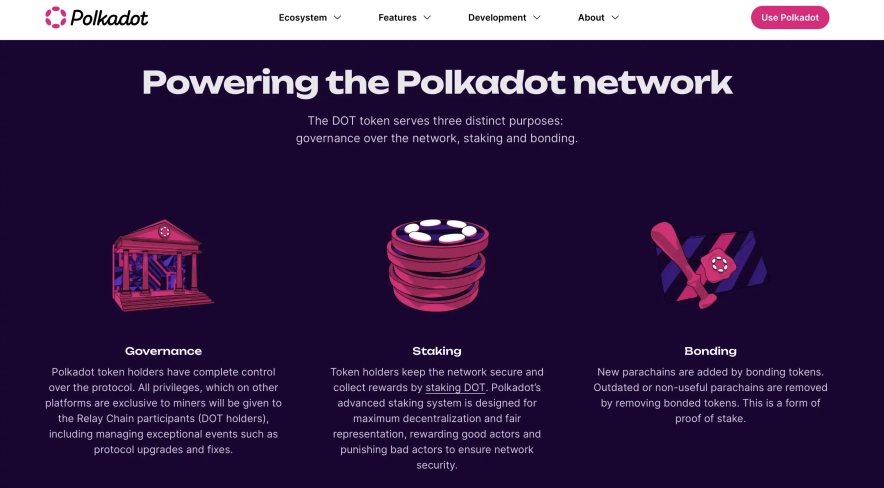
The DOT cryptocurrency performs several key functions within this ecosystem:
Network governance — DOT holders can vote on protocol changes, propose improvements, and participate in the platform’s development through an on-chain governance mechanism
Staking and security — tokens are used to secure the network via the Nominated Proof-of-Stake (NPoS) mechanism, where validators and nominators earn rewards for honest participation
Parachain bonding — projects that want to connect their blockchain to Polkadot must lock a certain amount of DOT for the duration of the parachain slot lease
Transaction fees — while parachains may use their own native tokens for transactions, DOT is used to pay fees at the relay chain level
The main strength of Polkadot lies in the fact that the platform was designed from the ground up with scalability and interoperability in mind — the two most critical challenges facing the modern blockchain industry. Thanks to parallel transaction processing across parachains, the network can theoretically handle millions of transactions per second, far exceeding the capabilities of Bitcoin or traditional Ethereum. At the same time, all parachains can freely exchange data through the Cross-Consensus Messaging protocol (XCMP), unlocking powerful opportunities for building complex decentralized applications that operate across multiple blockchains simultaneously.
Polkadot Ecosystem – History, Technology, and Tokenomics
The project was conceived as a foundation for Web 3.0 — a decentralized internet of the future where users control their own data, and applications operate without censorship or a single point of failure. Gavin Wood, the creator of Polkadot, envisions a future in which thousands of specialized blockchains are united into a single ecosystem, with each chain performing its role as efficiently as possible, while users remain unaware of the underlying technical complexity. In essence, this is an attempt to build blockchain infrastructure that is as seamless and invisible as today’s internet — after all, you don’t think about TCP/IP when watching a video on YouTube.
The History of the Polkadot Project and Its Mission
The history of Polkadot did not begin from scratch — its roots trace back to Ethereum, the project that revolutionized the blockchain industry in 2015. Behind this story stands a remarkable figure: Gavin Wood, a British programmer and computer science researcher who already had more than 15 years of open-source development experience by the time he met Vitalik Buterin. Wood was not just one of Ethereum’s co-founders — he became its first Chief Technology Officer, wrote a significant portion of the early blockchain code, authored the legendary “Yellow Paper” (the project’s technical specification), and, most importantly, created the Solidity smart contract programming language, which today powers thousands of decentralized applications.
CEO of the project
Together with Buterin, Charles Hoskinson (future creator of Cardano), Anthony Di Iorio, Joseph Lubin, and other early participants, Wood met in January 2014 in Miami at what was originally planned as a hackathon but became a pivotal moment in the creation of Ethereum. The team envisioned Ethereum as “one computer for the entire planet” — a vast ecosystem where users could create and modify digital products without censorship or restrictions. However, after two years serving as CTO of the Ethereum Foundation, Wood decided to leave the project in 2016.
The official reason for his departure was not publicly stated, but insiders cite serious disagreements over funding, development pace, and the project’s technical direction. Frustration with Ethereum’s management sparked the idea that became the foundation of Polkadot — the desire to create a “chain of chains,” a blockchain of blockchains, a protocol of protocols. Wood aimed to go deeper technologically than anything achieved with Bitcoin or Ethereum and then “package” the result, making it accessible to everyone as a foundational element for any blockchain.
Polkadot’s official website
In mid-2016, aiming to start fresh, Wood, together with mathematician Dr. Jutta Steiner, founded Parity Technologies, a company focused on building core blockchain infrastructure, developer tools, and client applications using the Rust programming language. In October 2016, the first draft of the Polkadot whitepaper was released, in which Wood outlined his vision for creating a “sharded version of Ethereum” with a fundamentally new architecture. Two years later, in 2018, Wood co-founded the Web3 Foundation — a non-profit organization that funds teams working on decentralized web technologies and specializes in decentralized internet infrastructure, starting with the Polkadot network.
In 2019, the team launched Kusama — an early experimental development environment for Polkadot, effectively a “canary network,” where new features could be tested in real-world conditions with actual economic incentives. Kusama became a proving ground for parachain mechanisms, slot auctions, and other innovative solutions that were later implemented in the main Polkadot network.
Note! Finally, in May 2020, the teams at Parity Technologies and the Web3 Foundation launched the main Polkadot network. Wood and his colleagues — Robert Habermeier and Peter Czaban — introduced a multichain platform designed to address what Wood himself called the “patchwork quilt of independent and isolated internet systems.” For Wood, this was an opportunity to build a blockchain architecture from scratch and create a new, non-toxic network — a parachain system that unites competing projects instead of forcing them to compete against each other.
Project Mission
The mission of Polkadot is to lay the foundation for Web 3.0 — a decentralized internet where users control their own data, and applications operate based on code rather than trust in centralized intermediaries. Wood described Polkadot as a next-generation blockchain designed to unite multiple blockchains into a single ecosystem, where each network can interact with others while maintaining its own rules, transaction fees, and performance characteristics. It is an attempt to create a global system of social and economic interaction “based on truth, not trust,” where projects collaborate for the benefit of the crypto economy rather than compete for ranking positions.
Cryptocurrency is needed for network management, staking, and bonding.
Polkadot was designed to address many of the issues Wood identified while working on Ethereum, including compatibility (interoperability), governance, and scalability. These design solutions later became central to the development of Polkadot as a platform for decentralized applications, DeFi services, and on-chain infrastructure. Interestingly, in October 2022, Wood unexpectedly announced his departure as CEO of Parity Technologies, sparking widespread discussion within the crypto community. However, this did not halt the ecosystem’s growth — Polkadot continues to evolve, attracting new projects and expanding its functionality.
Polkadot Multi-Platform: Technical Features
Diving into the technical details, Polkadot is a true engineering marvel — a full-fledged multichain architecture that functions like an operating system for other blockchains. At the core of this design is the concept of heterogeneous sharding, where instead of a single congested chain, there is an entire network of specialized blockchains operating in parallel and exchanging data. Let’s take a closer look at how this works in practice.
Relay Chain — the Heart of the Ecosystem
At the center of Polkadot’s architecture is the Relay Chain — the network’s main blockchain, which acts as both coordinator and security guarantor for all connected parachains. Essentially, the Relay Chain functions as the backbone of the system: it does not execute smart contracts or process user transactions (those tasks are handled by the parachains), but focuses exclusively on coordination, validation, and maintaining consensus. The Relay Chain organizes and secures the operations of the parachain network while providing them with specific properties and overall network security.
Technically, the Relay Chain is a directed acyclic graph (DAG) of state transitions, where each newly added block can be viewed as the head of a chain or a fork with cumulative state. The blockchain forms a tree structure, as each block can have only one parent, and all paths through the DAG lead back to the Genesis block. A pool of validators operates on the Relay Chain, randomly assigned to add and validate blocks across different parachains.
Polkadot Ecosystem
Parachains — Parallel Blockchains
If the Relay Chain is the backbone, then parachains are like the organs of the body, each performing its own specialized function. Parachains are independent layer-one blockchains that operate in parallel within the Polkadot ecosystem, inheriting the security of the Relay Chain while maintaining their autonomy. Their parallel nature allows for distributed transaction processing and incredible protocol scalability — a concept known as horizontal scalability.
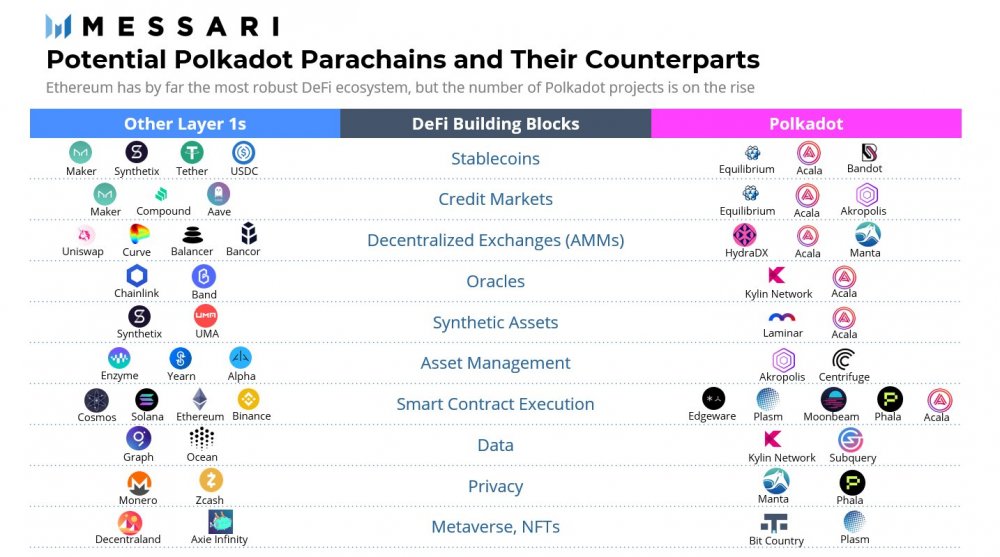
Each parachain is a fully deterministic state machine, maintaining its own state, executing batches of transactions bundled into blocks, and reaching new states. Parachains can have their own economy with native tokens, their own transaction validation rules, and custom data processing logic — essentially, each parachain can be designed for a specific purpose. For example, one parachain might be optimized for DeFi applications, another for NFT marketplaces, and a third for data storage, all running simultaneously without interfering with one another.
Polkadot and Kusama Parachains
Currently, Polkadot supports around 100 parachains, and this number is expected to grow to several hundred in the future. Parallel transaction processing through parachains gives developers tremendous freedom to experiment and create innovative, customized solutions.
Collators and Validators
Parachains are maintained by specialized network operators called collators. A collator node’s role is to support a full parachain node, store all necessary parachain data, and produce new candidate blocks to be sent to the Relay Chain validators. Collators collect user transactions and create Proof-of-Verification (PoV) blocks, which are then submitted to the validators.
Relay Chain validators check these candidate blocks and confirm that the state transitions have been executed correctly. A key requirement is that the parachain’s logic must be verifiable by the Relay Chain validators, ensuring the security of the entire system. As a result, new parachains immediately benefit from Polkadot’s overall network security, even if they are just launched — they don’t need to build their own independent validator network.
GitHub
XCM — The Cross-Chain Communication Language
One of Polkadot’s most impressive features is the ability for parachains to communicate with each other through the XCM protocol (Cross-Consensus Message Format). This message format enables cross-consensus communication, allowing parachains to exchange data, assets, and function calls. Imagine one parachain requesting another to perform an action or transfer tokens — all done securely and without relying on any third party.
There is, however, a minor detail: there is a slight delay between sending a message from one parachain and receiving it on the target parachain. In an optimistic scenario, this delay usually takes at least two blocks — one block for sending the message and one block for processing it on the receiving parachain. But this is a small price to pay compared to what is impossible in most other blockchain systems.
Advantages of Polkadot Ecosystem Coins
Parachain Slot Allocation
Since the number of parachain slots is limited (around 100), there are several ways to allocate them:
Grants — for system parachains that are designated by Polkadot network governance and are part of the protocol (e.g., bridges to other networks)
Auctions — projects compete for parachain slots by locking DOT tokens for a specified lease period
Parathreads — a more cost-effective option for projects that do not require continuous bandwidth
When a parachain wins an auction, the DOT tokens it pledged are reserved for the duration of the lease and cannot be transferred. At the end of the lease, the tokens are unlocked, and the project can either extend the lease or switch to parathread mode.
Parathreads — Pay-Per-Use Model
Parathreads are a lightweight version of parachains that operate on a “pay-as-you-go” basis. They use the same API as parachains but are scheduled for execution through an auction for each block. Essentially, parathreads share validators among themselves, making them slightly slower than full parachains but significantly more cost-effective. This makes them an ideal solution for startups and smaller projects that do not require continuous high throughput.
Bridges and Cross-Chain Integration
Finally, Polkadot supports bridges to external blockchain networks such as Bitcoin and Ethereum. These protocol bridges allow tokens and data to move between Polkadot and other blockchains, creating a truly global interoperable ecosystem. System parachain bridges do not have their own economic model and help offload transactions from the Relay Chain, enabling more efficient processing of operations.
DOT is the main token of the Polkadot ecosystem.
Note! This entire architecture with heterogeneous sharding enables Polkadot to achieve economic and transactional scalability that is unattainable for traditional monolithic blockchains. By distributing transactions across multiple parallel blockchains, latency is reduced and the number of processed operations increases, allowing developers to build truly scalable applications on the platform.
Polkadot Network Consensus
Polkadot uses an advanced consensus mechanism called Nominated Proof-of-Stake (NPoS)—a modified version of the classic Proof-of-Stake that introduces new participants and makes the network more decentralized. Unlike traditional PoS, where large token holders gain a significant advantage, NPoS divides roles between validators and nominators, creating a fairer system that is better protected against centralization.
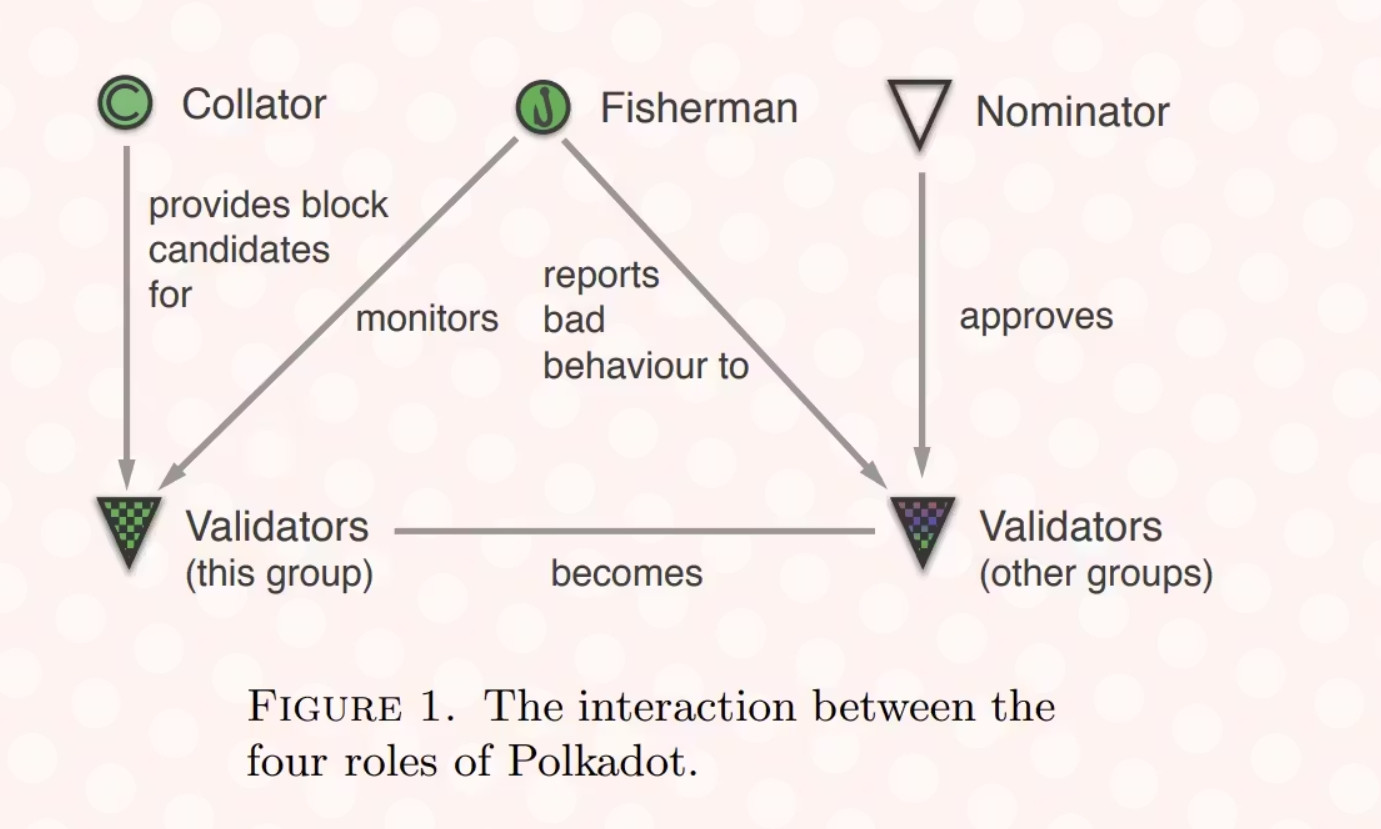
Collator, nominator, validator, and “fisherman”
Validators are the main actors in the network, running full Relay Chain nodes and responsible for producing new blocks, validating candidate blocks from parachain collators, and ensuring transaction finality. To become a validator, one must stake a significant amount of DOT tokens (the exact requirement varies depending on competition) and maintain reliable technical infrastructure — if a validator behaves dishonestly or attempts to attack the network, their tokens can be partially or fully confiscated through the slashing mechanism. For honest work, validators earn rewards in the form of newly minted DOT tokens issued by the network, along with a portion of transaction fees.
Nominators are DOT holders who do not want or cannot run their own validator nodes but still want to participate in securing the network and earn rewards. Nominators select up to 16 trusted validators and delegate their tokens for staking. A key point: nominators are responsible for their choice of validators — if a chosen validator violates the rules and is slashed, the nominator will also lose part of their staked tokens. This creates a strong incentive to select reliable validators with good reputations and technical capabilities.
The system operates in cycles called eras, typically lasting 24 hours. At the start of each era, a special algorithm selects the active set of validators based on staked tokens and nominations. Currently, Polkadot has approximately 297–300 active validators at any given time, although this number can change through governance votes. This level of participation provides a solid balance between decentralization and network efficiency.
Kusama (KSM)
Collators, as mentioned earlier, collect transactions within parachains and create candidate blocks with a proof-of-validity, which are then sent to Relay Chain validators for verification and inclusion in the overall consensus. Interestingly, collators are not required to stake DOT (although parachains may set their own requirements), but they earn rewards from their respective parachain for their work.
Block finalization in Polkadot is handled through the GRANDPA protocol (GHOST-based Recursive ANcestor Deriving Prefix Agreement), which provides fast and deterministic transaction finality. Unlike Bitcoin’s probabilistic finality, which requires waiting for multiple confirmations, GRANDPA guarantees that a block will not be reverted — finalization typically takes just a few seconds. This combination of block production via BABE (Blind Assignment for Blockchain Extension) and finalization through GRANDPA creates a fast and secure consensus capable of processing thousands of transactions per second while maintaining a high level of decentralization.
DOT Token Overview
The DOT token is the native cryptocurrency of the Polkadot ecosystem, serving not just as a medium of exchange but as a multifunctional tool that powers the entire network. In September 2025, a historic event took place: the Polkadot community, through its decentralized governance (DAO), voted to introduce a hard cap on the total token supply — 2.1 billion DOT. This decision fundamentally changed the project’s tokenomics, replacing the previous model of unlimited issuance, which had allowed for the annual release of 120 million new tokens.
Polkadot (DOT) Overview
The new issuance model introduces a two-year inflation schedule, after which the total number of tokens will be capped at the fixed maximum. Under this model, the total supply is projected to reach around 1.91 billion DOT by 2040, compared to 3.4 billion under the old system. Annual issuance will decrease from 120 million to 55 million DOT, significantly reducing inflationary pressure on the token and making it more attractive for long-term investors.
Key DOT Token Metrics:
Parameter
Value
Current Price
$2.07–2.12 (January 2026)
Market Capitalization
~$3.4–3.7 billion
Market Cap Rank
#33–45 on CoinGecko/CoinMarketCap
Circulating Supply
~1.52–1.65 billion DOT
Total Supply
~1.52–1.64 billion DOT
Maximum Supply
2.1 billion DOT (introduced in 2025)
24h Trading Volume
$71–274 million
All-Time High (ATH)
$55.00 (November 4, 2021)
All-Time Low (ATL)
$1.41 (October 10, 2025)
Launch Year
2020
The DOT token serves three key roles within the Polkadot ecosystem, making it indispensable for the network’s operation:
Governance — DOT holders gain voting rights in the decentralized network governance system, allowing them to propose protocol changes, vote on upgrades, participate in council elections, and influence the project’s direction. This on-chain governance enables Polkadot to update without hard forks, a unique feature of the platform.
Staking — DOT tokens secure the network through the Nominated Proof-of-Stake (NPoS) mechanism. Validators stake DOT to earn the right to produce blocks and validate transactions, while nominators delegate their tokens to validators in exchange for rewards. The system includes slashing — rule violators lose part of their staked tokens, incentivizing honest behavior.
Parachain Bonding — projects wishing to connect their blockchain to Polkadot as a parachain must win a slot auction and lock a specified amount of DOT for the entire lease period (usually 6 months to 2 years). This ensures that only serious and vetted projects join the network and creates additional demand for the token.
Additionally, DOT is used to pay transaction fees at the Relay Chain level, although parachains may use their own tokens for internal operations. The versatility of DOT and its central role in all major network processes make it a foundational element of the Polkadot ecosystem.
The decision to cap the maximum supply was a significant step toward a deflationary model, similar to Bitcoin, where a fixed limit creates scarcity and potentially supports long-term token value. Following this announcement in September 2025, DOT’s price rose by 9.8% within a week, although the market later corrected. Nevertheless, the fundamentally new tokenomics structurally make Polkadot more attractive for long-term investors.
Staking Polkadot (DOT) with Ledger Wallet
Ways to Acquire DOT Tokens
If you want to become a DOT holder, there are several options — ranging from straightforward exchange purchases to more advanced methods of earning through active participation in the ecosystem. Let’s break down all the possibilities, from the simplest to those requiring some knowledge and capital.
Buying on Cryptocurrency Exchanges
The most obvious and fastest way to acquire DOT is to purchase it on a centralized exchange. The token is listed on nearly all major platforms, including Binance, Bybit, OKX, Coinbase, Kraken, and many others. The process is straightforward: register, complete KYC verification, fund your account with fiat or stablecoins, and buy DOT at the market price. We’ll cover exchanges and purchase details in the next section, but for now, it’s worth noting that this is the most accessible option for beginners.
Staking via Nominating
Here’s where it gets really interesting — you can not only hold DOT, but also put them to work and earn passive income through staking. Polkadot offers annual yields ranging from 10% to 15%, depending on market conditions and the validator you choose. There are two main staking options:
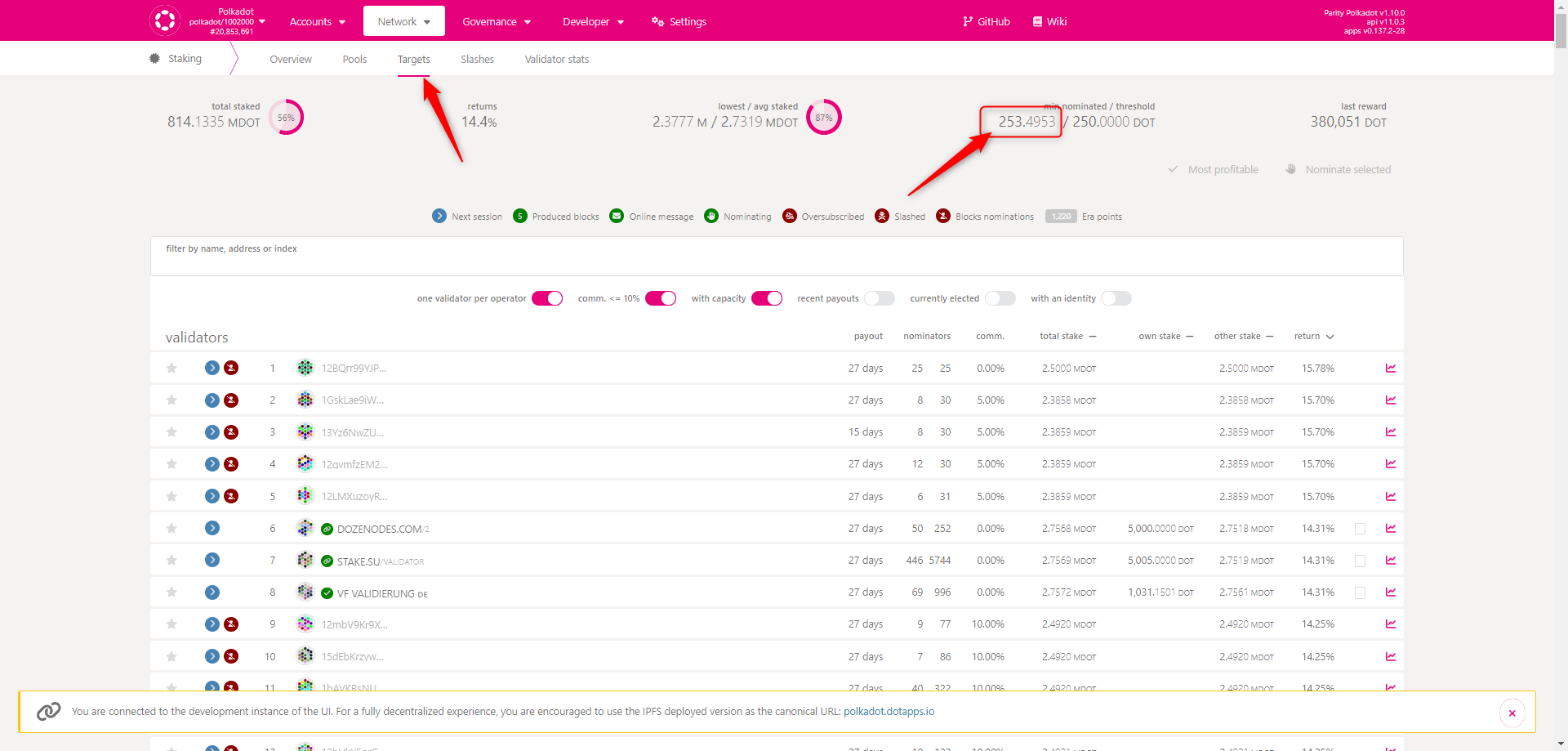
Direct Nominating — you select up to 16 validators from the active set and delegate your tokens to them. Previously, the minimum threshold was 250 DOT, but due to competition, it has increased to around 550–600 DOT (as of 2024–2026). This approach offers maximum flexibility and potentially higher returns if you carefully choose validators with low fees and high uptime.
Nomination Pools — ideal for those with smaller amounts of capital. Pools allow staking from as little as 1 DOT by combining funds with other participants. Rewards are distributed proportionally to your share in the pool, minus the pool operator’s fee. This is perfect for small investors who want to participate in staking without deep technical knowledge.
Important: When staking through the official Polkadot wallet (Polkadot.js or its forks), tokens are locked for a minimum of 28 days. This is called the unbonding period — during this time, you cannot sell or transfer your DOT. Rewards are credited every era (approximately every 24 hours) and are automatically reinvested, creating a compound interest effect.
Polkadot.js
Staking on Exchanges
Many exchanges offer simplified DOT staking directly on their platforms — you just move your tokens to the Earn/Staking section, and the exchange handles validator nominations for you. Yields are usually slightly lower (around 8–12% annually), but there’s no need to deal with technical settings, and there are often no strict lock-up periods. However, it’s important to remember the golden rule of crypto: “Not your keys, not your coins” — tokens held on an exchange are technically owned by the platform, exposing them to risks like hacks or fund freezes.
Participating in Parachain Crowdloans
One of the most exciting ways to earn with DOT is by participating in parachain crowdloans. When a new project wants to secure a Polkadot parachain slot, it launches a crowdloan campaign, allowing users to “lend” their DOT to the project for the auction. If the project wins a slot, your tokens are locked for the entire lease period (usually 48 to 96 weeks), and in return, you receive rewards in the native tokens of that parachain.
The key point is that your DOT are not spent — they are simply frozen and returned to you once the lease ends. Projects often offer generous bonuses: for example, early participants in crowdloans for Acala, Moonbeam, Astar, and other popular parachains received tokens that multiplied in value after listing. Participation is possible via the official Polkadot.js interface or through exchanges like Binance and Kraken, which support crowdloans.
From a technical standpoint, participating in a crowdloan does not require KYC, as Polkadot is a decentralized, permissionless network. However, some parachain teams may impose their own restrictions, particularly for U.S. citizens and other jurisdictions. Participation is also possible using a Ledger hardware wallet, adding an extra layer of security.
Running a Validator
For technically skilled users with significant capital, there’s the option to become a validator and earn rewards directly. Validators are responsible for verifying transactions, producing blocks, and maintaining network security. The requirements are serious: you need a powerful server with high uptime (ideally 99.9%+), technical expertise to configure and maintain a node, and a substantial DOT stake (usually equivalent to several hundred thousand dollars). In return, potential earnings are higher than for nominators, especially if you set low commission fees and attract a large number of nominators.
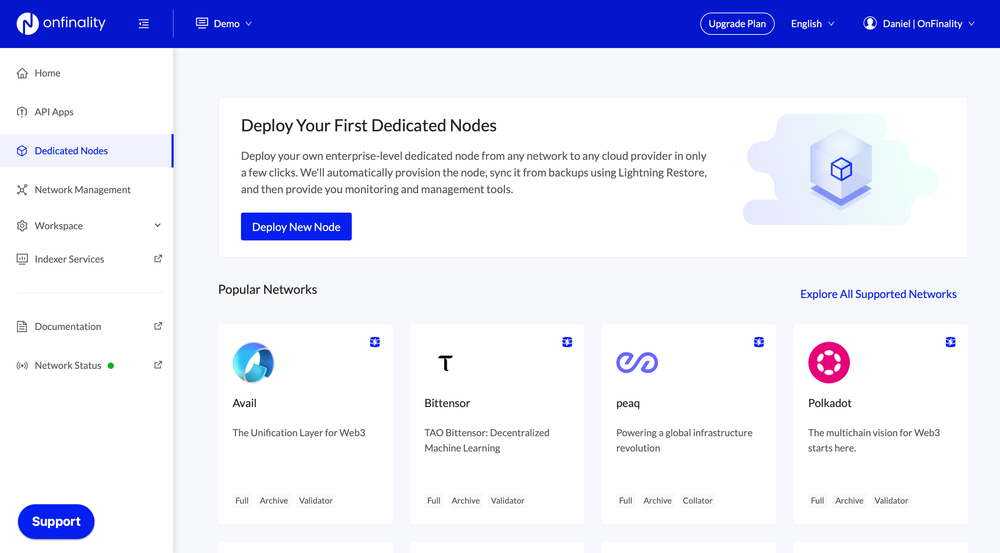
Dedicated Nodes
The risk is that validators are subject to slashing — if you violate protocol rules (for example, signing two blocks simultaneously or being offline for too long), a portion of your staked tokens will be confiscated. Nominators also share this risk, so it’s crucial to choose reliable validators with strong reputations.
Participating in Governance and Bounties
A less common but effective way to earn DOT is by taking part in on-chain governance and completing tasks through the Treasury Bounties program. DOT holders can propose protocol improvements, vote on proposals, and receive rewards for actively contributing to the ecosystem’s development. Polkadot’s Treasury periodically funds projects and tasks, offering grants in DOT for activities such as tool development, creating educational content, security audits, and much more.
Note! Overall, there are plenty of ways to earn DOT for every level of involvement — from passive staking on an exchange to actively contributing to the development of the entire ecosystem. The key is to understand the risks and never invest more than you’re willing to lose, as the cryptocurrency market remains volatile, even for fundamentally strong projects like Polkadot.
Where to Buy and Store Polkadot (DOT) Cryptocurrency
Buying and securely storing DOT are two key aspects for anyone looking to invest in the Polkadot ecosystem. The good news is that the token is available on almost all major exchanges, and there are plenty of reliable storage options—from mobile apps to hardware wallets. Let’s explore the best places to buy DOT and how to properly manage its storage.
How to buy Polkadot (DOT)
The easiest and fastest way to acquire Polkadot is through centralized cryptocurrency exchanges, where the token is available in dozens of trading pairs with fiat currencies and stablecoins. Here are the top platforms to consider:
Binance — the world’s largest cryptocurrency exchange by trading volume, where DOT is available in pairs with USDT, BUSD, BTC, EUR, and many other assets. The platform offers not only spot trading but also DOT futures, as well as the opportunity to participate in parachain crowdloans directly on the platform. Fees are low (0.1% for makers and takers, even lower when using BNB), and DOT can be staked immediately through Binance Earn with an annual yield of 8–12%.
Bybit — a popular exchange among traders, originally focused on derivatives but now offering full-featured spot trading. DOT can be purchased with USDT and other crypto assets, with options for margin trading. Bybit is known for its advanced trading platform, low latency, and user-friendly technical analysis tools.
OKX — one of the top five exchanges by liquidity, providing a wide range of services from spot trading to advanced DeFi products. On OKX, you can buy DOT with fiat (via credit card or P2P), trade futures and options, and use built-in staking. The exchange supports over 340 cryptocurrencies and offers competitive fees.
MEXC — a fast-growing exchange often among the first to list new Polkadot parachain tokens. If you participate in crowdloans and receive new parachain tokens, they often appear first on MEXC. DOT can be bought in pairs with USDT and BTC, standard fees are 0.2%, and there is a loyalty program to reduce trading costs.
BingX — a relatively new exchange emphasizing social trading (copy trading) and a beginner-friendly interface. DOT is available for both spot and futures trading and can be purchased with USDT. BingX attracts new investors with its simplicity and educational resources.
WEEX — a lesser-known but reliable platform with good liquidity for major trading pairs. The exchange offers competitive fees and regular promotions for new users. DOT is traded against USDT, with both basic and advanced trading interfaces available.
When choosing an exchange, consider factors such as availability in your region, fiat deposit options (bank cards, P2P, bank transfers), fee levels, mobile app availability, and platform reputation. For beginners, Binance or OKX are optimal choices due to their intuitive interfaces, Russian-language support, and maximum liquidity.
Storing tokens on an exchange is convenient for active trading but carries risks of hacks or fund freezes. Let’s look at alternative options:
js Apps — the official web interface for interacting with the Polkadot network, available at polkadot.js.org/apps. It allows users to create a wallet, manage balances, stake tokens, and participate in governance and crowdloans. Polkadot.js is a powerful tool for advanced users, but its interface may feel overwhelming for beginners. An important note: this is a web application, so private keys are stored locally in the browser, making it critical to back up your seed phrase.
Nova Wallet — a top mobile wallet for the Polkadot ecosystem, supporting over 100 networks and more than 410 cross-chain transfers. Nova Wallet features easy-to-use staking, governance voting participation, DApp integration via WalletConnect, and even a Polkadot debit card to spend DOT anywhere. The interface is user-friendly, open-source, and community-oriented. Available for both iOS and Android.
Trust Wallet — one of the most popular multi-currency wallets supporting DOT and parachain tokens. Over 210 million users worldwide trust Trust Wallet for its security, ease of use, and wide functionality. The wallet allows purchasing DOT with fiat directly in-app, built-in swapping via DEX aggregators, security scanning, and encrypted cloud backups. Available as a mobile app (iOS/Android) and browser extension.
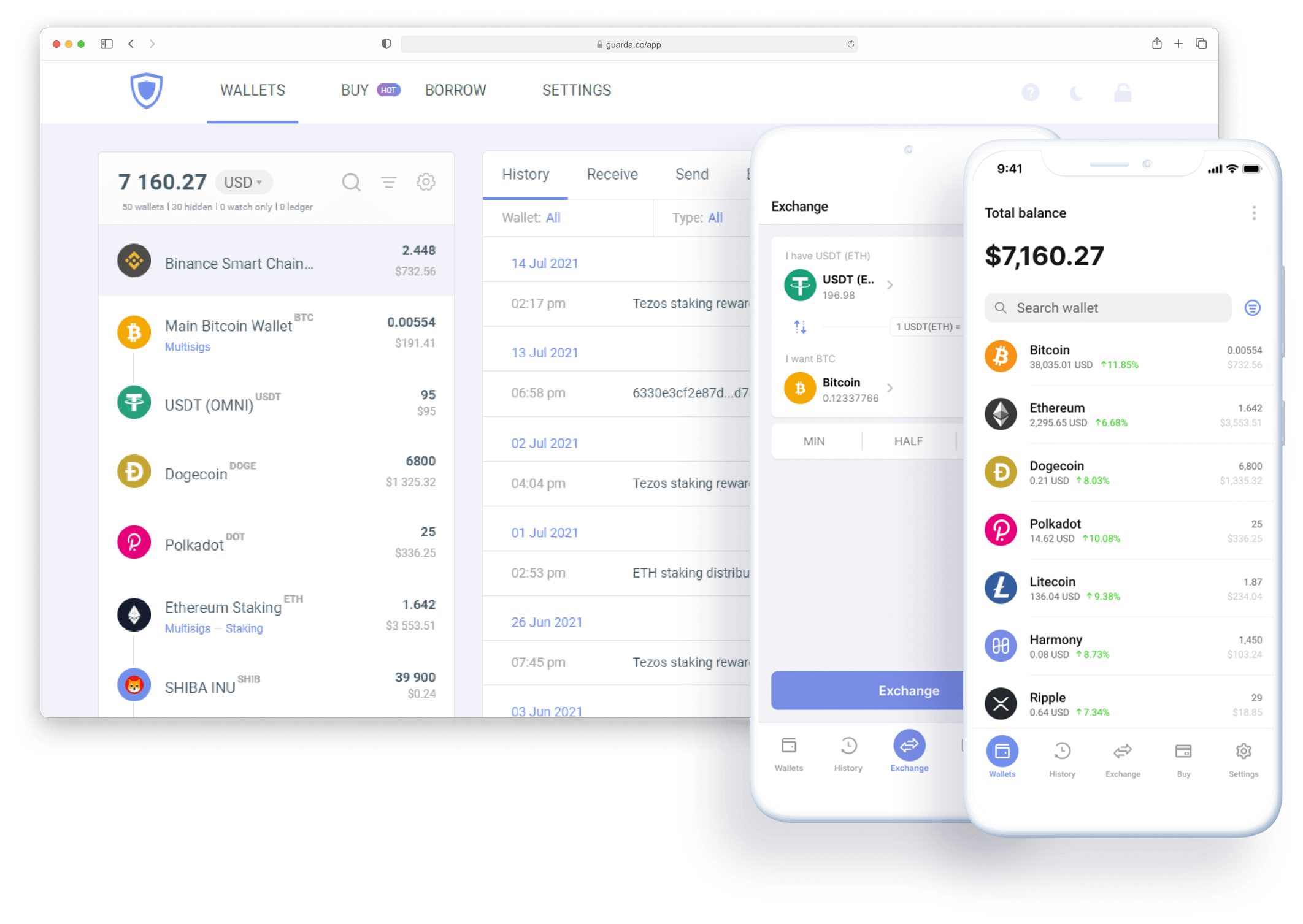
Guarda Wallet — another versatile wallet supporting DOT and over 50 other cryptocurrencies. Guarda offers a web version, desktop applications (Windows, Mac, Linux), mobile versions, and even a browser extension. With Guarda, you can store, send, receive, and instantly exchange DOT at competitive rates through integrated partners.
Guarda Wallet
For maximum security, especially when storing significant amounts, hardware wallets are worth considering. These are physical devices that keep private keys offline. Ledger Nano S/X and Ledger Nano S Plus officially support Polkadot and can be used together with Polkadot.js Apps for staking and account management. To use DOT on a Ledger device, you need to install the Polkadot app via Ledger Live, then connect the device to polkadot.js.org/apps to access your accounts.
The process is straightforward: launch Ledger Live, update the firmware, install the Polkadot app, then in Polkadot.js Apps settings select “Attach Ledger via WebUSB.” You can then manage your balance, stake, and sign transactions directly through the hardware wallet. This is the most secure storage method, as private keys never leave the device. Other popular options include Trezor, which also supports DOT, and Cypherock — a next-generation multisignature hardware wallet.
Security Recommendations
Regardless of the storage method you choose, follow these basic security rules:
Never share your seed phrase (12–24 words) with anyone — it grants full access to your funds.
Create backups of your seed phrase on paper or metal plates and store them in different locations.
Double-check recipient addresses before sending — blockchain transactions are irreversible.
For long-term storage (holding), use hardware wallets or non-custodial mobile apps.
For active trading, keep only the amount on exchanges that you are willing to risk.
Remember: cryptocurrencies give you the role of your “own bank,” but with great freedom comes great responsibility for securing your funds. Take the time to set up safe storage, and your DOT will remain secure whether you are staking, participating in crowdloans, or simply holding in anticipation of growth.
Investment Outlook and Prospects for Polkadot
At the time of writing, Polkadot is trading at approximately $2.32, showing a daily gain of over 13% following an extended correction. The yearly high reached $7.60, while the low dropped to $1.65, reflecting the asset’s high volatility. Its market capitalization is around $3.84 billion, keeping DOT within the top 40 cryptocurrencies by this metric.
From a fundamental perspective, Polkadot is at an interesting stage of development. The introduction of a hard supply cap of 2.1 billion tokens in September 2025 has significantly altered the project’s tokenomics, making it more attractive to long-term investors. The shift toward a deflationary model, similar to Bitcoin, creates scarcity effects that could potentially support the price in the medium term. By 2040, the total supply is expected to reach 1.91 billion DOT instead of 3.4 billion under the old model, representing a significant reduction in inflationary pressure.
A promising pair of tokens for investment
The technical outlook for Polkadot looks promising. The rollout of Polkadot 2.0 upgrades includes improvements in scalability, an asynchronous backing (Async Backing) system that speeds up block production times, and elastic scaling to increase parachain throughput. The ecosystem continues to expand: around 100 parachains are already active on the platform, including successful projects like Moonbeam, Astar, Acala, and dozens of other DeFi, NFT, and gaming platforms.
Regarding price forecasts, analysts are divided. Optimistic scenarios predict DOT could reach $3.50–$5.53 by the end of 2026 if the market enters a bullish phase and Polkadot continues attracting new projects. More conservative estimates suggest a range of $2.50–$4.00, still implying potential growth of 20–70% from current levels. In the long term (2027–2030), some experts see DOT reaching $8–$15 if the project fulfills its potential as a core infrastructure for Web 3.0.
Risks should also be considered. Polkadot faces strong competition from Ethereum (especially after its shift to PoS and Layer 2 solutions), Cosmos, Avalanche, and other multichain platforms. The project’s success largely depends on its ability to attract high-quality parachains and deliver real value to users, rather than just speculative interest. Gavin Wood’s departure from the CEO position at Parity Technologies in 2022 also raised questions about future leadership, though development continues at an active pace.
What is Polkadot?
Staking with annual yields of 10–15% makes DOT attractive for passive income, potentially sustaining baseline demand for the token regardless of market fluctuations. Participating in parachain crowdloans provides opportunities for early investment in promising ecosystem projects, which has historically delivered significant profits to early participants.
Note! Overall, Polkadot remains one of the most technologically advanced blockchain projects, supported by a strong development team and a growing ecosystem. For investors with a 1–3 year horizon and tolerance for volatility, DOT may present an interesting opportunity, especially when purchased at current levels after a 70% correction from the annual high. However, as with any crypto investment, diversification is crucial, and you should only invest funds you can afford to lose.
Conclusion
Polkadot is an ambitious attempt to build the foundation for a decentralized internet of the future. Over the years, Gavin Wood’s team has successfully implemented the revolutionary concept of an “internet of blockchains,” where dozens of independent networks operate in parallel, exchanging data and assets without intermediaries. Its unique parachain architecture, advanced NPoS consensus mechanism, and focus on interoperability set Polkadot apart from hundreds of competing platforms.
The DOT token has gained new momentum following the introduction of a hard supply cap of 2.1 billion coins, making the project’s economic model more attractive for long-term investors. Opportunities to earn 10–15% annual yields through staking, participate in parachain crowdloans, and influence protocol development through on-chain governance create a full ecosystem of benefits for token holders. Meanwhile, the growing ecosystem—with around 100 active parachains and a steady influx of new projects—demonstrates the platform’s real utility rather than mere speculative interest.
Of course, Polkadot faces significant competition from Ethereum, Cosmos, and other multichain solutions, and the cryptocurrency market remains unpredictable and volatile. However, fundamentally, the project is one of the most technologically advanced in the industry, backed by a strong development team, an active community, and a clear long-term strategy. For those who believe in the future of Web 3.0 and are ready for medium- to long-term investments, Polkadot presents an interesting opportunity to be part of the global transformation of the internet.
The Crypto Insite team recommends thoroughly researching the project, starting with small amounts, and gradually building your position through staking and active participation in the ecosystem. Remember basic security practices: use hardware wallets for large sums, avoid storing all funds on exchanges, and invest only what you can afford to lose. The cryptocurrency market is a marathon, not a sprint, and patient investors with a multi-year horizon have historically achieved the best results.
FAQ. Frequently Asked Questions
How is Polkadot different from Ethereum?
The main difference between Polkadot and Ethereum lies in their architectural approach to scalability and interoperability. Ethereum is a monolithic blockchain, where all applications compete for limited block space, leading to high fees during periods of congestion. Polkadot, on the other hand, uses a heterogeneous sharding model, where multiple specialized blockchains (parachains) operate in parallel, each with its own logic and rules, yet all are secured through the shared relay chain. Interestingly, Gavin Wood created both projects—he was a co-founder of Ethereum and the developer of Solidity, and Polkadot became his attempt to address the scalability and governance challenges he observed on Ethereum. However, these projects do not compete directly; bridges exist between the networks, and many projects leverage both ecosystems for different purposes.
Is it safe to invest in DOT?
Like any cryptocurrency, DOT is subject to high volatility and market risks—the token can lose 50–70% of its value in a bearish market, as seen when it fell from $7.60 to $1.65 in 2025. However, from a fundamental perspective, Polkadot is one of the most technologically advanced projects, with a strong development team, a growing parachain ecosystem, and real use cases. The introduction of a hard supply cap of 2.1 billion tokens improved tokenomics, making DOT more attractive for long-term holding. It is important to remember that crypto investments always carry the risk of total loss, so the basic rule is to invest only what you can afford to lose. Portfolio diversification, using hardware wallets for storage, and dollar-cost averaging (DCA) strategies can help minimize risks.
How much can you earn from DOT staking?
DOT staking yields roughly 10–15% annually, depending on the method and market conditions. If you nominate validators directly via Polkadot.js (requiring a minimum of 550–600 DOT), you can achieve up to 14–15% by choosing validators with low commission and high uptime. Through nomination pools, where the minimum stake is just 1 DOT, the yield is slightly lower—around 12–13% due to pool operator fees. Staking on exchanges like Binance or OKX typically offers 8–12% annual returns, requiring no technical knowledge and often without strict lock-up periods. Direct staking involves a 28-day unbonding period during which tokens cannot be sold or transferred. Rewards are distributed each era (approximately every 24 hours) and are automatically reinvested, creating a compounding effect.
What are parachains and why are they needed?
Parachains are independent layer-1 blockchains operating in parallel within the Polkadot ecosystem, inheriting the security of the relay chain while maintaining their autonomy. Think of them as separate “lanes” on a multi-lane highway—each parachain processes its transactions simultaneously with others, dramatically increasing scalability. Each parachain can have its own token economy, validation rules, and logic—one optimized for DeFi, another for NFTs, another for gaming. The key feature is that all parachains can exchange data and assets through the XCM protocol, creating a truly interoperable ecosystem where projects collaborate rather than compete for resources. Currently, Polkadot hosts around 100 parachains, including successful projects like Moonbeam, Astar, and Acala, with growth expected to reach several hundred in the future.
Does DOT have a maximum supply?
Yes, since September 2025, DOT has a hard cap of 2.1 billion tokens. This historic decision was made by the Polkadot community via decentralized governance (DAO) and fundamentally changed the project’s tokenomics. Previously, Polkadot had an uncapped inflation model, issuing 120 million new tokens annually as rewards for stakers and validators. The new model introduces a two-year inflation period, after which annual issuance will drop to 55 million DOT, and by 2040, the total supply is expected to be around 1.91 billion instead of 3.4 billion under the old system. This makes DOT more similar to Bitcoin with its deflationary model, where a hard cap creates scarcity and potentially supports long-term value. As of January 2026, approximately 1.52–1.65 billion DOT are in circulation, meaning over 70% of the maximum supply has already been issued.
Crypto market expert. A practicing investor in financial and cryptocurrency markets with over 9 years of experience.
Specializations: cryptocurrencies, DeFi tools, crypto exchanges, and exchangers.
I participate in token sales, earn through holding, staking, and DeFi tools. I actively trade on crypto exchanges, test various cryptocurrency services, and share my knowledge with the website's readers. Always up to date with current events and well-versed in the latest trends in the cryptocurrency industry.